Epiglottitis PowerPoint Template





Template Preview
Designed for healthcare professionals creating clear and structured medical presentations.
Ideal for doctors, medical educators, and pharmaceutical teams preparing lectures, clinical education, product presentations, and training.
Fully editable in PowerPoint, allowing you to customize diagrams, charts, and slide layouts with your own medical content
Ready-to-use presentation structure that saves time and helps you build professional healthcare presentations quickly.
Fully Animated
Built-in animations help you present medical information clearly and make complex concepts easier to understand.
Editable Colors and Shapes
Editable colors and shapes help you easily customize the slides to match your content and presentation style, just drag and drop your content.
Professional medical layouts
Professional medical layouts help you organize clinical information, medical data, and treatment insights in a clear and structured way.

Created by Medical Professionals
This template prioritizes medical accuracy, clarity, and real-world usability. Each slide is designed with a medical audience in mind, helping you present clinical information, data, and treatment insights in a way that is structured, credible, and easy for healthcare professionals to understand.
Medical Training for Pharmaceutical & Life Sciences Companies
Recognizing epiglottitis fast becomes second nature once new hires have worked through the template's tripod-position and stridor symptom slides alongside the thumbprint-sign X-ray finding that confirms the diagnosis. Representatives on an ENT, emergency medicine, or pediatric vaccine team study the Haemophilus influenzae etiology and the Hib vaccination schedule, covering the 2-, 4-, 6-, and 12-month doses, before they are cleared to discuss prevention messaging with pediatricians and family physicians. The airway-obstruction pathogenesis sequence gives trainers a scientifically grounded emergency-medicine foundation without needing a critical-care illustrator on staff. New hires leave onboarding able to explain both why epiglottitis is an emergency and how vaccination has changed its incidence.
Medical Congress & Scientific Conference Presentations
Building an emergency-medicine congress session on epiglottitis no longer means sourcing separate throat-anatomy and thumbprint-sign imagery --- the template's labeled anatomy diagrams and X-ray illustration already give emergency physicians, ENT specialists, and anesthesiologists that foundation. A medical professor lecturing on airway management can adapt the endotracheal intubation and cricothyroidotomy slides to walk through the emergency airway-security pathway. The bacterial pathogenesis sequence, from epithelial penetration through T-cell activation to airway obstruction, gives a case presentation a clear mechanistic anchor before the discussion turns to management. Presenters arrive ready to layer in their own case timeline rather than rebuilding the anatomy from separate references.
Pharmaceutical Product & Medical Affairs Presentations
Hib vaccination awareness materials take shape faster around the template's four-dose schedule graphic and its Haemophilus influenzae etiology content, giving Medical Affairs a ready foundation for a pediatric vaccine or anti-infective portfolio. Medical Science Liaisons carry the resulting materials into scientific exchange with pediatricians and emergency medicine physicians, referencing the same epidemiology and age-susceptibility data those clinicians already recognize. Because the etiology, pathogenesis, and prevention content sit in separate sections, Medical Affairs can shift emphasis toward vaccination messaging or acute-treatment positioning depending on the therapy area. The finished materials remain an editable scientific starting point, with promotional review left to each company's own process.
eLearning & SCORM Training Modules
Emergency medicine and pediatric anesthesia educators can customize the Epiglottitis template with their own institutional airway protocols, then optionally convert the finished presentation into a SCORM-compliant module for residents or nursing staff on an LMS. Left unedited, the template is a structured clinical reference, not a finished course. Because the anatomy, etiology, pathogenesis, and management content already follows an emergency-response teaching sequence, a customized version becomes certification-ready SCORM coursework without a separate instructional-design pass. Where a program needs something more specific, the RxSlides team can adjust scope, depth, or branding, or build a fully custom emergency-medicine presentation from scratch.
Medical & Healthcare Education
Emergency medicine and pediatric faculty teaching pediatric airway emergencies can use the template's tripod-position and stridor symptom slides to help students recognize epiglottitis quickly, instead of relying on text descriptions of a presentation students may never have seen firsthand. Continuing education providers preparing CME on the Croup-versus-Epiglottitis differential benefit from the same throat-anatomy and pathogenesis content, without rebuilding comparison slides for every course. Editable vaccination-schedule slides let an instructor tailor the prevention discussion to a pediatrics, nursing, or public-health audience. Students leave with a clear, memorable framework for recognizing and responding to a pediatric airway emergency.
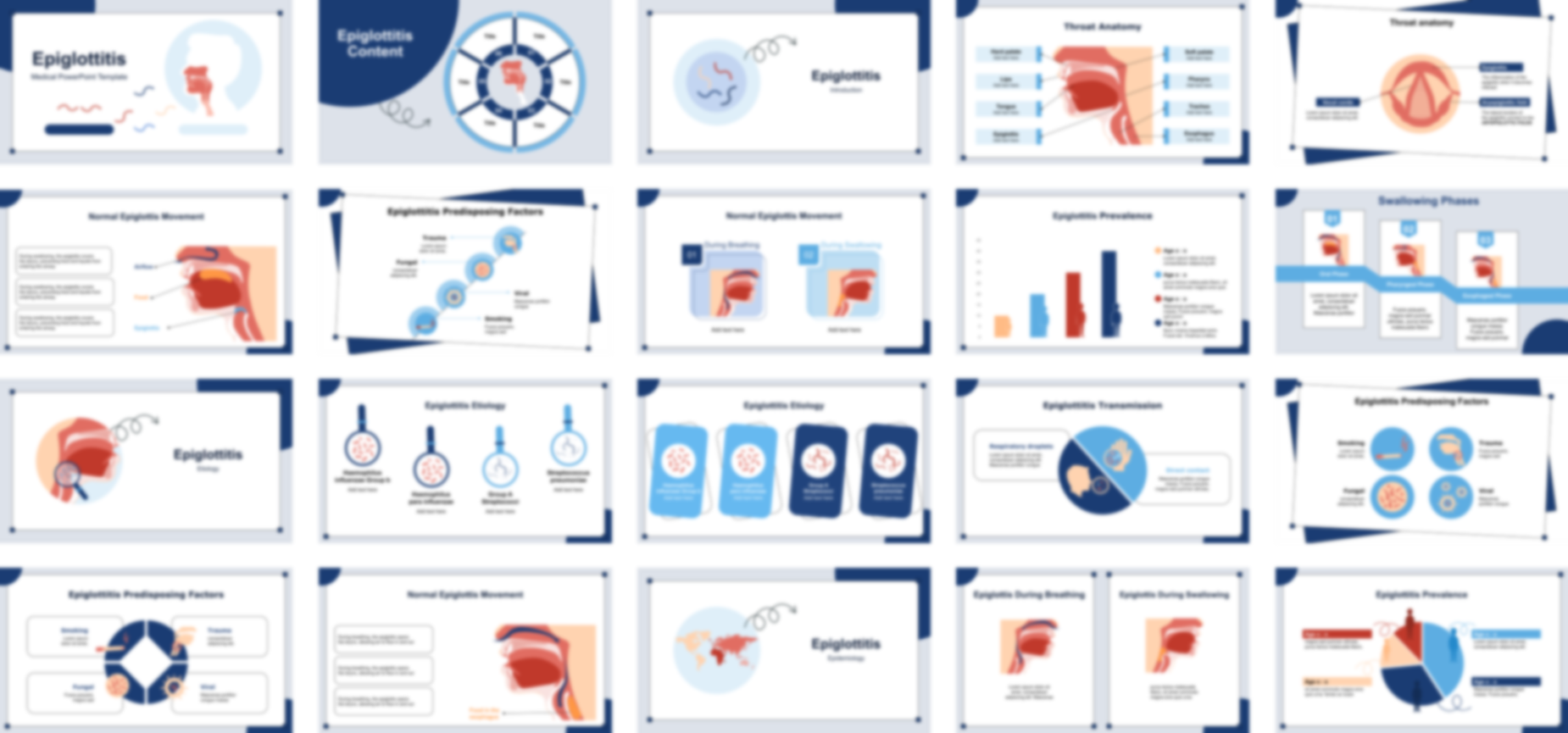
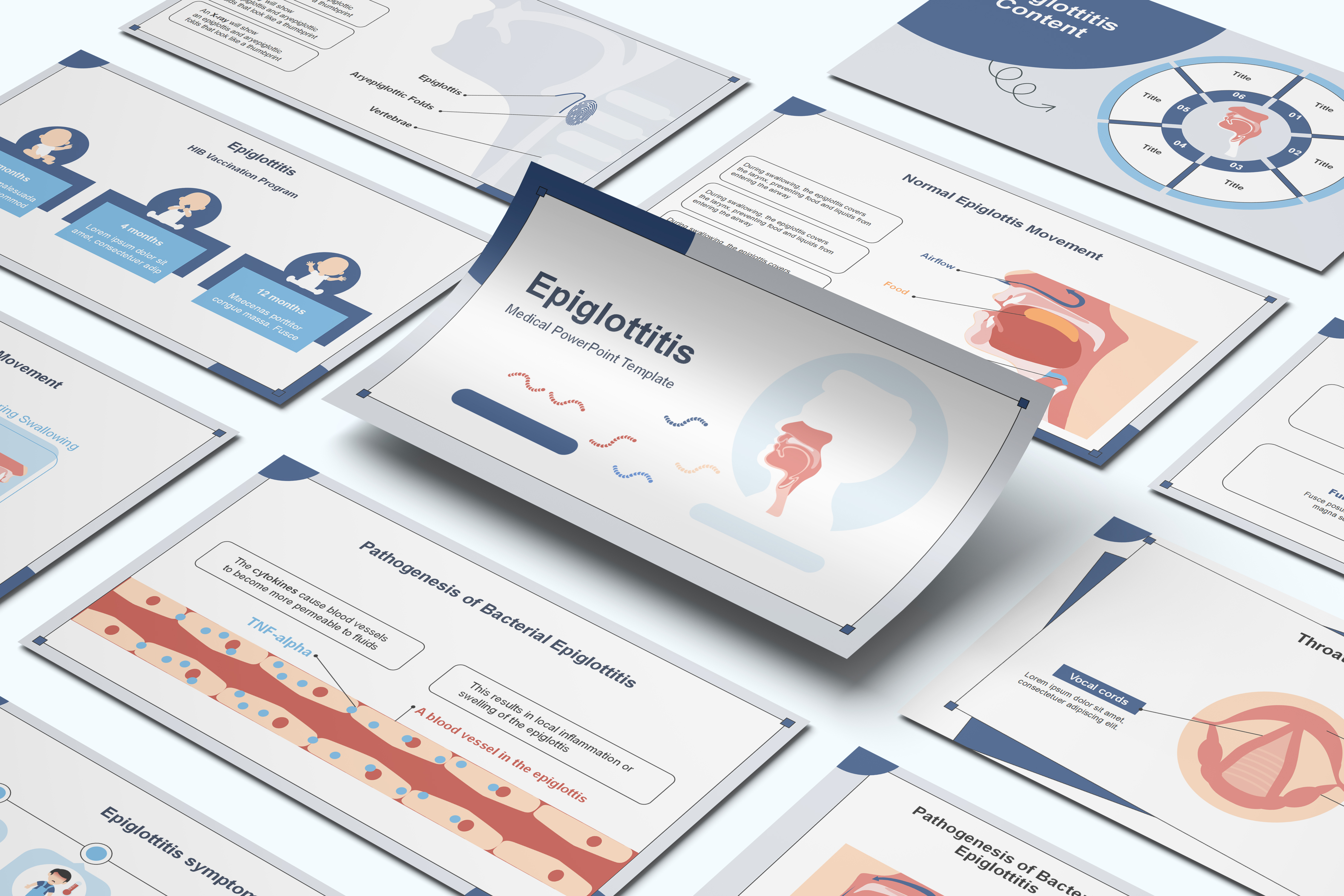
The Epiglottitis PowerPoint template opens with a title slide and six point table of contents before detailed diagrams label the throat anatomy, including the epiglottis, vocal cords, and aryepiglottic fold. Further animated slides contrast the epiglottis's normal movement during breathing and swallowing and break down the three phases of the swallowing process in editable PowerPoint diagrams.
Magnifying glass icons identify the key bacterial pathogens responsible for epiglottitis, including Haemophilus influenzae and Streptococcus pneumoniae, before further icons cover predisposing factors such as smoking, trauma, and fungal or viral infection. A world map and bar and pie charts then visualize prevalence, transmission through respiratory droplets and direct contact, and the two to seven year age range of highest susceptibility.
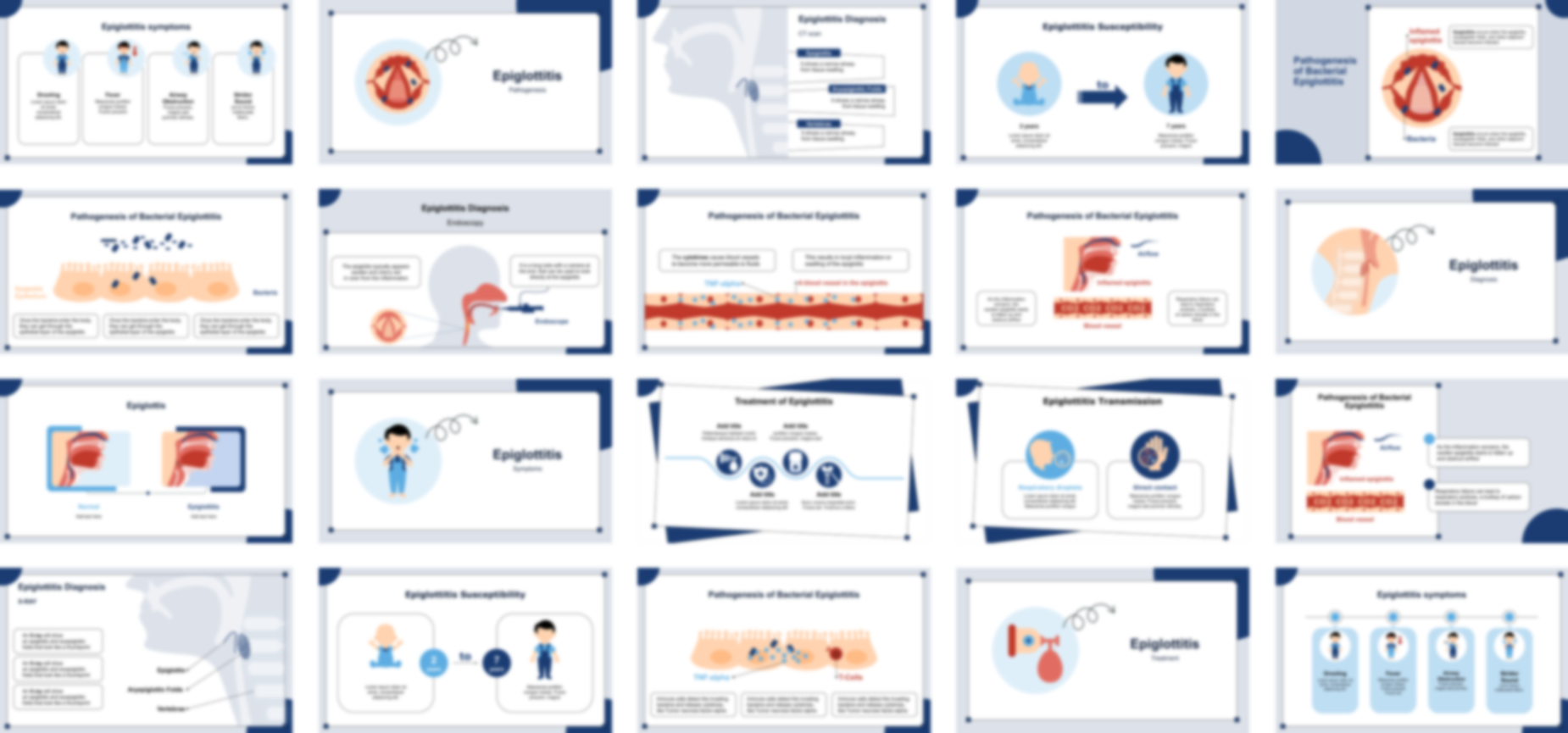
Animated diagrams trace the pathogenesis from bacterial penetration of the epiglottis epithelium through the immune response and inflammation to the resulting airway obstruction. Establishing this cellular mechanism first gives educators a shared reference point before icons illustrate the four key symptoms, fever, drooling, airway obstruction, and the stridor sound.
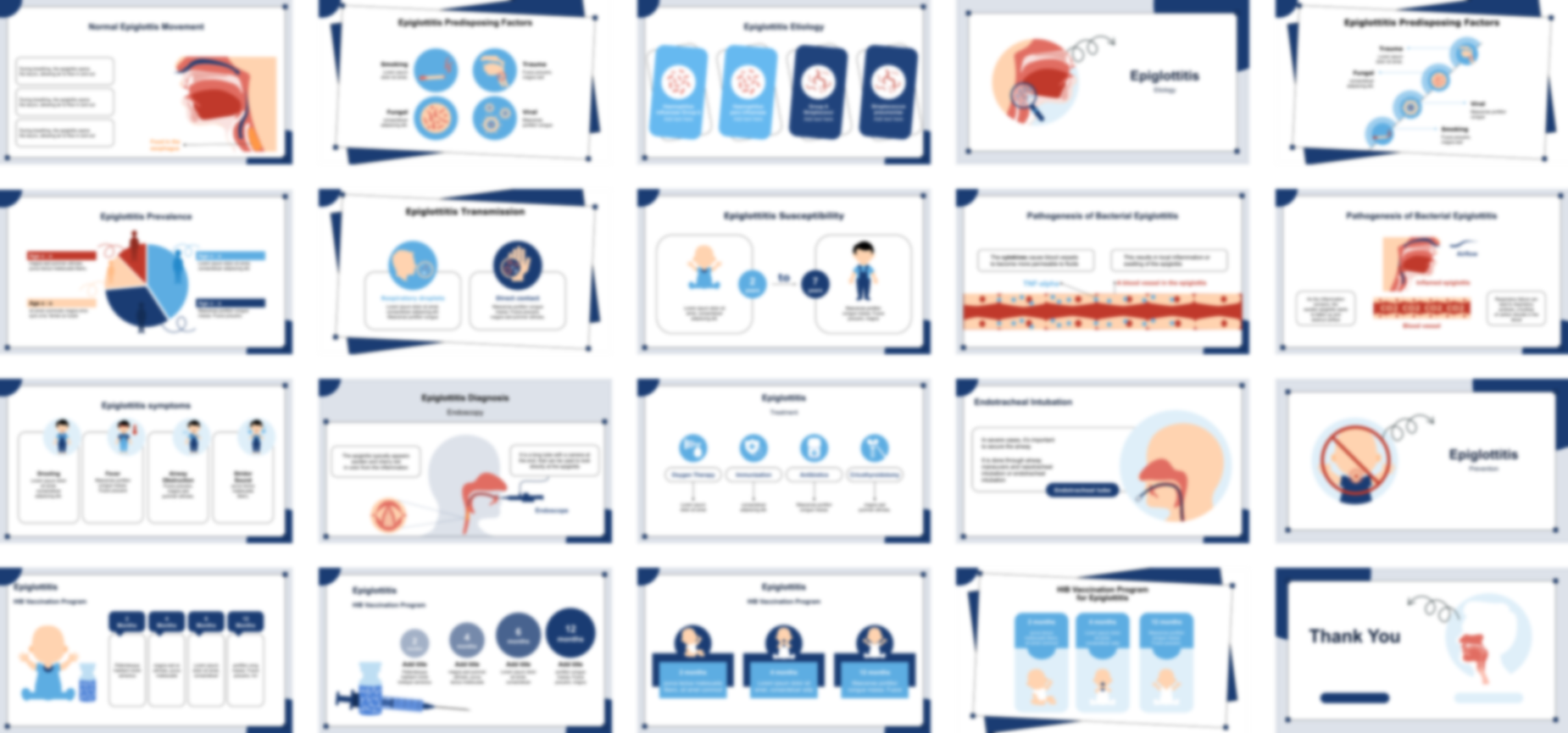
The medical presentation template covers diagnostic methods including x-ray, CT scan, and endoscopy before detailing four treatment methods, oxygen therapy, antibiotics, immunization, and cricothyroidotomy, plus endotracheal intubation for securing the airway. The presentation closes with the HiB vaccination schedule for prevention, at two, four, six, and twelve months, ending with a thank you slide.
Ready To Transform Your Presentation ?
Pay once, use forever