Irritable bowel syndrome (IBS) PowerPoint Template

%2520PowerPoint%2520Template.jpeg)




Template Preview
Designed for healthcare professionals creating clear and structured medical presentations.
Ideal for doctors, medical educators, and pharmaceutical teams preparing lectures, clinical education, product presentations, and training.
Fully editable in PowerPoint, allowing you to customize diagrams, charts, and slide layouts with your own medical content
Ready-to-use presentation structure that saves time and helps you build professional healthcare presentations quickly.
Fully Animated
Built-in animations help you present medical information clearly and make complex concepts easier to understand.
Editable Colors and Shapes
Editable colors and shapes help you easily customize the slides to match your content and presentation style, just drag and drop your content.
Professional medical layouts
Professional medical layouts help you organize clinical information, medical data, and treatment insights in a clear and structured way.

Created by Medical Professionals
This template prioritizes medical accuracy, clarity, and real-world usability. Each slide is designed with a medical audience in mind, helping you present clinical information, data, and treatment insights in a way that is structured, credible, and easy for healthcare professionals to understand.
Medical Training for Pharmaceutical & Life Sciences Companies
Gastroenterology-focused sales teams can ground IBS onboarding in the template's gut-brain axis animation, which traces the two-way relationship between the enteric nervous system and the brain before a single symptom is introduced. Representatives study the three-type classification, constipation-predominant, diarrhea-predominant, and mixed, alongside the Bristol stool chart used to characterize each, before they are cleared to hold promotional conversations with gastroenterologists and dietitians. The FODMAP diet and medication-change treatment slides give trainers a complete management-pathway foundation without needing a GI illustrator on staff. New hires leave onboarding able to trace a patient's symptoms back to the underlying gut-brain mechanism, not simply match them to a checklist.
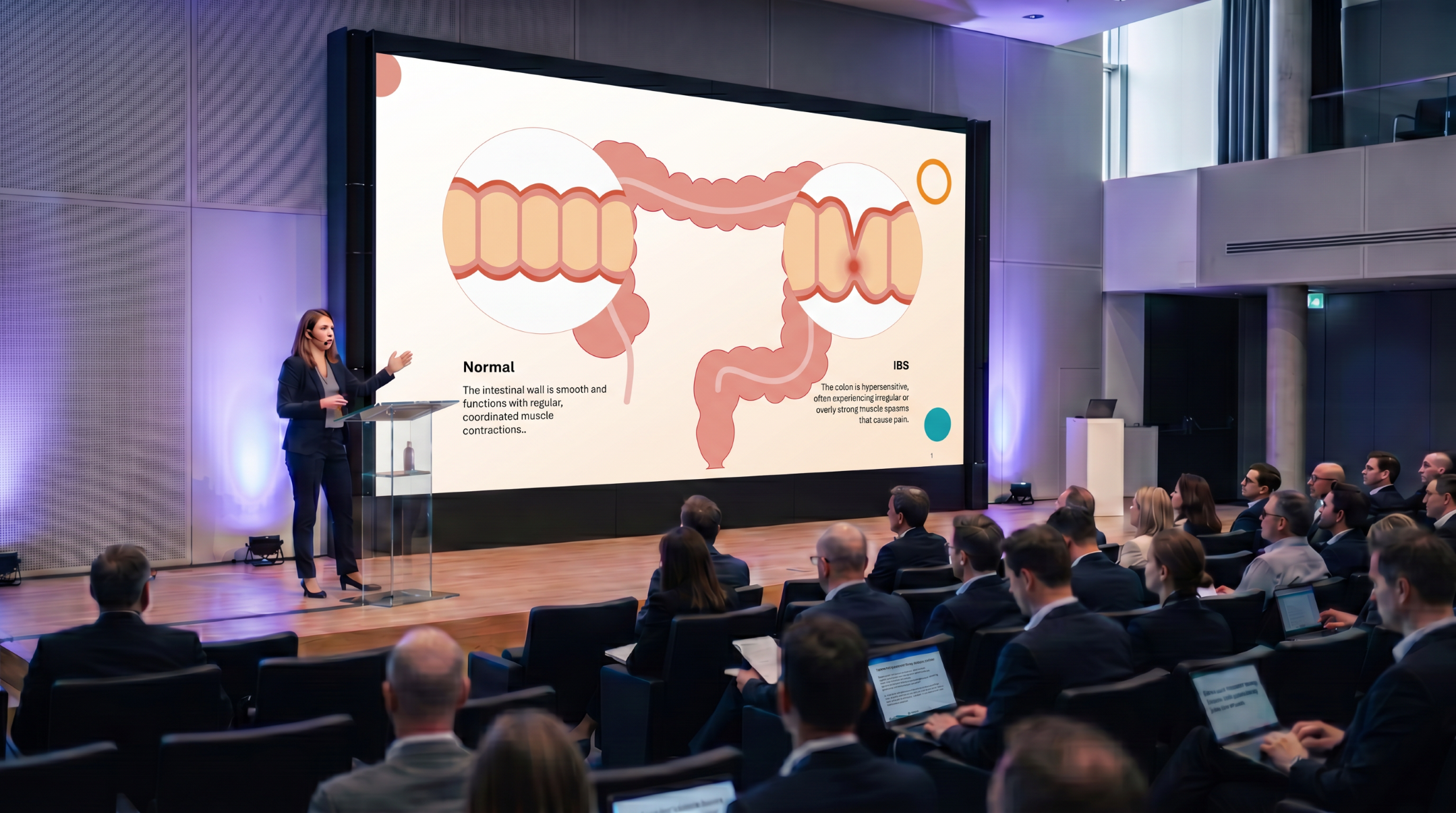
Medical Congress & Scientific Conference Presentations
A GI congress session on functional bowel disorders can move straight from mechanism to clinical management using the template's animated gut-brain axis and abdominal-pain pathogenesis sequences, rather than gastroenterologists and academic Key Opinion Leaders assembling mechanism diagrams from separate journal figures. A medical professor lecturing on differential diagnosis can adapt the diagnostic-methods overview, spanning blood tests, colonoscopy, and sigmoidoscopy, to walk through the diagnostic workup in sequence. The diarrhea-versus-constipation comparative animation gives a case presentation a clear mechanistic anchor before the discussion turns to dietary management. What starts as a mechanism template becomes a full clinical talk with the presenter's own case data layered in.

Pharmaceutical Product & Medical Affairs Presentations
Positioning a GI therapy within IBS management is easier when the trigger, cause, and diarrhea-versus-constipation mechanism content is already built into the template Medical Affairs teams adapt for a gastroenterology portfolio. Medical Science Liaisons carry the resulting materials into scientific exchange with gastroenterologists and dietitians, referencing the same Bristol stool chart and symptom data those clinicians already use to characterize patient presentations. Because the causes, types, and treatment content sit in separate sections, Medical Affairs can shift emphasis toward a specific therapy class without commissioning new illustrations. That groundwork stays scientifically accurate on its own, with promotional decisions left to each company's own review process.

eLearning & SCORM Training Modules
Dietitians and GI nurse educators can customize the IBS template with their own meal-planning protocols and patient case examples, then optionally convert the finished presentation into a SCORM-compliant module for nutrition students or GI nursing staff on an LMS. As shipped, the 60-plus-slide template is a content library, not a finished course. Because the definition, causes, pathogenesis, and treatment content already follows a teaching sequence, a customized version becomes certification-ready SCORM coursework without a separate restructuring pass. Where a program needs something the base structure doesn't cover, the RxSlides team can adjust scope, depth, or branding, or build a fully custom digestive-health presentation from scratch.
Medical & Healthcare Education
Gastroenterology and nutrition faculty teaching functional bowel disorders can point students to the template's Bristol stool chart as a shared diagnostic reference, instead of sourcing new clinical imagery each term. Continuing education providers preparing CME on IBS subtypes benefit from the same constipation-versus-diarrhea comparative content, instead of rebuilding classification slides for every course. Dietitians and patient educators adapting the trigger and FODMAP-diet slides for patient-facing sessions can simplify the same content while keeping the underlying science accurate. Students and patients alike leave with a clearer picture of how IBS moves from gut-brain dysfunction to dietary control.
-slides-design-preview-1.png)
-slides-design-preview-2.png)
-slides-design-preview-3.png)
The Irritable Bowel Syndrome PowerPoint template opens with medical animated cover slides before a definition slide frames IBS as a group of uncomfortable gastrointestinal symptoms. Prevalence data follows in an infographic with editable percentages and countries, breaking down IBS rates at both global and local levels.
Medical icons visualize triggers such as stress, infections, and medications alongside causes including dysmotility, visceral hypersensitivity, and brain gut dysfunction before comparative illustrations distinguish IBS with constipation, diarrhea, and mixed bowel habits. Successive animated slides then walk through the Bristol stool chart, used to help diagnose constipation, diarrhea, and IBS, in this set of editable PowerPoint slides.
Medical animation illustrates the gut brain axis, the two way relationship in which stress affects gut microbiota and gut microbiota affects the central nervous system, stimulating IBS symptoms. Establishing this shared mechanism first gives educators a common reference point before further animations explain how abnormal nerve sensitivity and unabsorbed carbohydrates drive abdominal pain, and how diarrhea and constipation differ in water reabsorption.
Medical icons represent symptoms including diarrhea, constipation, bloating, and recurrent abdominal pain before medical illustrations cover diagnostic criteria such as blood tests, colonoscopy, and sigmoidoscopy. The medical presentation template closes with treatment options including diet change, such as the FODMAP diet, medication change, and activity change, plus complications like poor quality of life and mood disorders.
Ready To Transform Your Presentation ?
Pay once, use forever