Dry Eye PowerPoint Template

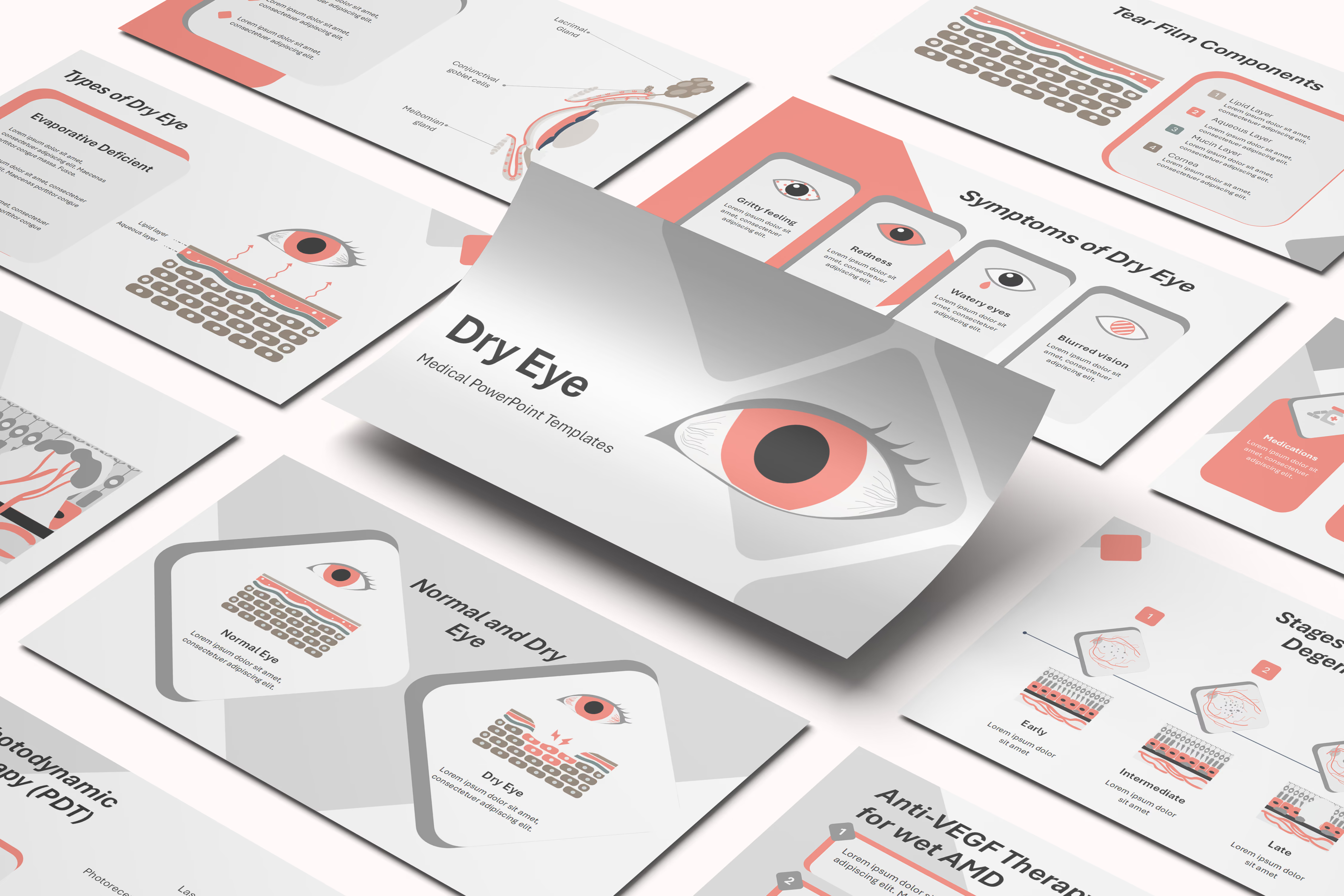




Template Preview
Designed for healthcare professionals creating clear and structured medical presentations.
Ideal for doctors, medical educators, and pharmaceutical teams preparing lectures, clinical education, product presentations, and training.
Fully editable in PowerPoint, allowing you to customize diagrams, charts, and slide layouts with your own medical content
Ready-to-use presentation structure that saves time and helps you build professional healthcare presentations quickly.
Fully Animated
Built-in animations help you present medical information clearly and make complex concepts easier to understand.
Editable Colors and Shapes
Editable colors and shapes help you easily customize the slides to match your content and presentation style, just drag and drop your content.
Professional medical layouts
Professional medical layouts help you organize clinical information, medical data, and treatment insights in a clear and structured way.

Created by Medical Professionals
This template prioritizes medical accuracy, clarity, and real-world usability. Each slide is designed with a medical audience in mind, helping you present clinical information, data, and treatment insights in a way that is structured, credible, and easy for healthcare professionals to understand.
Medical Training for Pharmaceutical & Life Sciences Companies
Ophthalmology and eye-care training teams onboarding new sales reps can structure introductory sessions around this 50-plus-slide Dry Eye template's tear-film component breakdown, contrasting normal tear-film structure against the three-way evaporative, aqueous-deficient, and mixed classification. New hires get a visual reference for the major causes, medications, hormonal change, age, and dry environment, alongside the four hallmark symptoms: gritty sensation, redness, blurred vision, and watery eyes. The diagnostic-workup content, covering Schirmer's testing and slit-lamp examination, gives trainees a structured clinical reference. New reps finish training able to connect a patient's dry-eye subtype to the treatment category it typically responds to.
Medical Congress & Scientific Conference Presentations
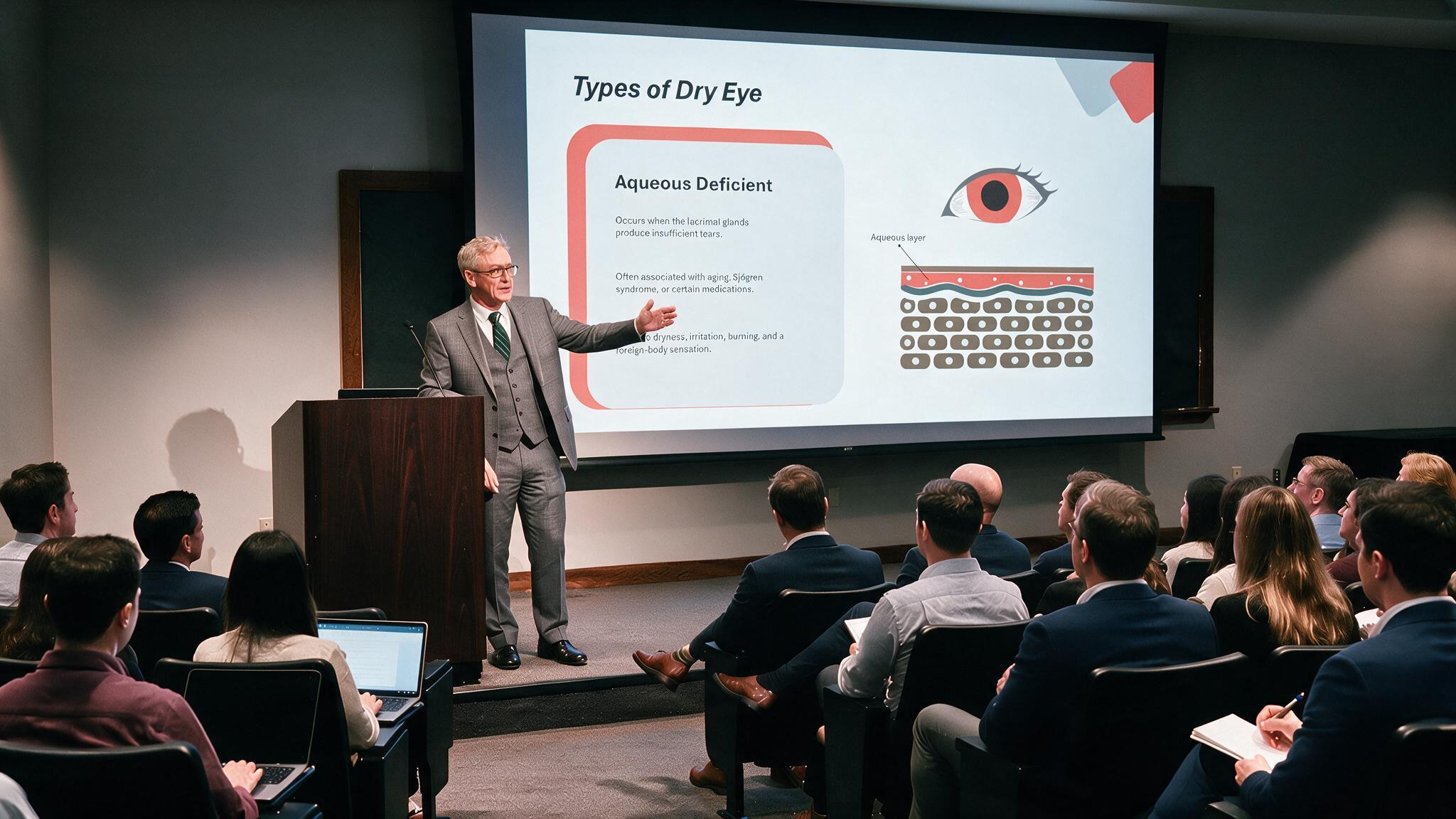
Ophthalmologists and optometrists preparing a conference session can build around this Dry Eye template's tear-film animation, comparing normal secretion and stability against the breakdown seen in each dry-eye subtype, rather than assembling ocular-surface diagrams independently. The evaporative-versus-aqueous-deficient-versus-mixed comparison gives a speaker a ready framework for a differential-diagnosis discussion. A Key Opinion Leader presenting at an ophthalmology or optometry conference can pair the existing prevalence content with their own clinic-level screening data. The Schirmer's-test and slit-lamp diagnostic content keeps the discussion clinically current for a specialist audience.

Pharmaceutical Product & Medical Affairs Presentations
Medical Affairs teams supporting a cyclosporine, lifitegrast, or broader ocular-surface product can use this Dry Eye presentation as disease-state groundwork for scientific exchange, covering tear-film physiology and the three-subtype classification before any product-specific data enters the conversation. Medical Science Liaisons can reference the diagnostic-testing content, Schirmer's test and slit-lamp examination, when a scientific exchange conversation calls for context on how a dry-eye diagnosis actually gets confirmed. Built around disease education rather than a specific product claim, the deck still needs the customer's own medical and compliance function to review it before it's used with any external audience. Ophthalmology and optometry teams gain a consistent scientific reference spanning diagnosis through management.

eLearning & SCORM Training Modules
Optometry schools and ophthalmology residency programs building an ocular-surface-disease module can customize this Dry Eye template with their own clinical images, then convert the finished presentation into a SCORM-compliant module for their learning management system when self-paced study fits the curriculum better. The tear-film and subtype-classification animations translate naturally into interactive checkpoints within a broader ophthalmology or optometry course. When a program needs a narrower scope, such as diagnostic testing alone or a version tailored for optometry versus ophthalmology learners, the RxSlides team can adjust the template's coverage and branding. Outside of what any current template covers, the RxSlides team can still put together a fully custom presentation from scratch.
Medical & Healthcare Education
Medical and optometry faculty teaching ocular surface disease can use this template's tear-film component slides to establish normal ocular physiology before introducing the three mechanisms behind dry-eye disease. The evaporative-versus-aqueous-deficient comparison gives students a clear framework for connecting a patient's presentation to its underlying tear-film defect. The Schirmer's-test and slit-lamp content connects classroom theory to the diagnostic tools students will use in clinical practice. Students leave with a structured understanding of dry eye spanning tear-film physiology, classification, diagnosis, and treatment.
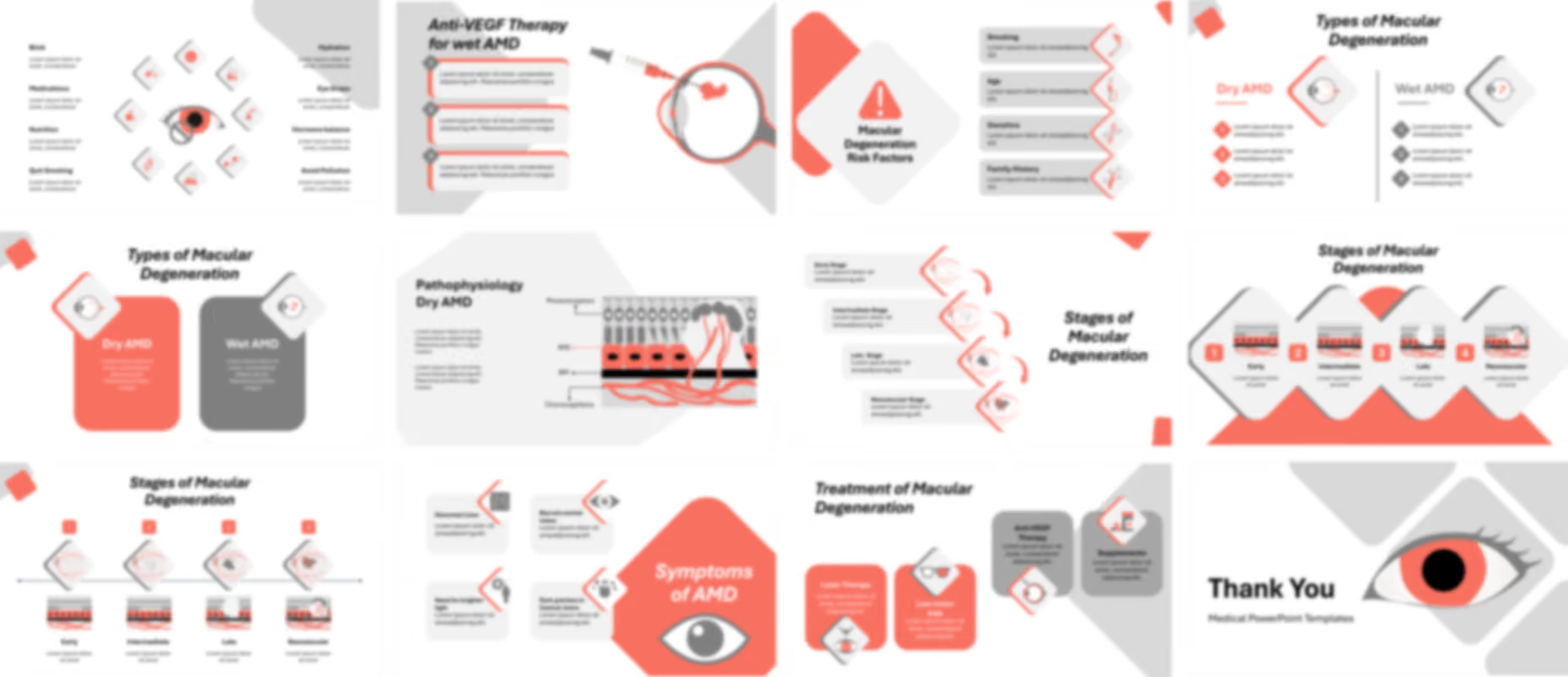
The Dry Eye PowerPoint template opens with an introductory cover slide and editable table of contents before animated slides illustrate the components of the tear film, the eye glands, and a comparison between a regular and a dry eye. An infographic then visualizes prevalence on a global and local level, with editable percentages and countries.
Medical icons represent causes such as medications, hormonal changes, age, dry environments, and underlying medical conditions before animated illustrations distinguish the three types of dry eye, evaporative, aqueous deficient, and mixed, based on which tear film layer is affected.
Illustrations of the eye explain symptoms including a gritty feeling, redness, blurred vision, and watery eyes before medical graphics cover diagnostic procedures such as eye examination, medical history, Schirmer's test, and slit lamp exam. Establishing the symptom picture first gives educators a shared reference point before the sequence moves into confirmatory testing.
Medical icons detail treatment options including medication, artificial tears, eye drops, and omega-3 supplements, which can be added to or removed as needed. The template closes with preventive measures such as blinking, hydration, nutrition, and avoiding pollution, plus a set of editable PowerPoint icons and illustrations.
Ready To Transform Your Presentation ?
Pay once, use forever