Laryngitis PowerPoint Template






Template Preview
Designed for healthcare professionals creating clear and structured medical presentations.
Ideal for doctors, medical educators, and pharmaceutical teams preparing lectures, clinical education, product presentations, and training.
Fully editable in PowerPoint, allowing you to customize diagrams, charts, and slide layouts with your own medical content
Ready-to-use presentation structure that saves time and helps you build professional healthcare presentations quickly.
Fully Animated
Built-in animations help you present medical information clearly and make complex concepts easier to understand.
Editable Colors and Shapes
Editable colors and shapes help you easily customize the slides to match your content and presentation style, just drag and drop your content.
Professional medical layouts
Professional medical layouts help you organize clinical information, medical data, and treatment insights in a clear and structured way.

Created by Medical Professionals
This template prioritizes medical accuracy, clarity, and real-world usability. Each slide is designed with a medical audience in mind, helping you present clinical information, data, and treatment insights in a way that is structured, credible, and easy for healthcare professionals to understand.
Medical Training for Pharmaceutical & Life Sciences Companies
Otolaryngology and primary care training teams onboarding new sales reps can structure introductory sessions around this 70-plus-slide Laryngitis template's larynx-anatomy foundation, epiglottis, vocal cords, and aryepiglottic fold, before moving into the acute-versus-chronic disease classification. New hires get a visual reference for the viral-versus-bacterial cause distinction, spanning RSV and rhinovirus through group A streptococcus and H. influenzae. The vocal-cord pathogenesis content, tracing goblet-cell mucus over-secretion through immune-mediated swelling, gives trainees a structured reference for why laryngitis produces hoarseness specifically. New reps finish training able to connect a specific cause to the corresponding treatment approach.
Medical Congress & Scientific Conference Presentations
Otolaryngologists preparing a conference session can build around this Laryngitis template's vocal-cord-vibration animation, tracing normal phonation through the mucosal swelling that disrupts it in acute disease, rather than assembling laryngeal-physiology diagrams independently. The viral-versus-bacterial cause comparison gives a speaker a ready framework for an etiology-driven treatment discussion. A Key Opinion Leader presenting at an ENT conference can pair the existing risk-factor content with their own institutional case data. The laryngoscopy-based diagnostic content keeps the discussion clinically current for a specialist audience.
Pharmaceutical Product & Medical Affairs Presentations
Medical Affairs teams supporting an antimicrobial, antitussive, or broader ENT portfolio can use this Laryngitis presentation as disease-state groundwork for scientific exchange, covering larynx anatomy and the viral-versus-bacterial etiology split before any product-specific data enters the conversation. Medical Science Liaisons can reference the pathogenesis content when a scientific exchange conversation calls for context on why vocal-cord swelling produces the characteristic hoarseness. The focus stays on disease mechanism rather than a specific therapy, so Medical Affairs still routes it through the customer's own medical and compliance function before any audience sees it. ENT and primary care teams gain a consistent scientific reference spanning cause, mechanism, and treatment.
eLearning & SCORM Training Modules
Otolaryngology residency programs and nursing schools building a laryngeal-disease module can customize this Laryngitis template with their own case studies, then convert the finished presentation into a SCORM-compliant module for their learning management system when self-paced study fits the curriculum better. The vocal-cord pathogenesis and cause-classification animations translate naturally into interactive checkpoints within a broader ENT course. When a program needs a narrower scope, such as the risk-factor content alone or a version tailored for nursing versus physician learners, the RxSlides team can adjust the template's coverage and branding. The RxSlides team remains available to design a fully custom presentation from scratch for any training objective the existing catalog doesn't reach.
Medical & Healthcare Education
Medical and nursing faculty teaching otolaryngology can use this template's larynx-anatomy slides to establish normal vocal-cord function before introducing how inflammation disrupts phonation. The viral-versus-bacterial cause framework gives students a clear structure for approaching a common condition with a broad differential. The pathogenesis content connects classroom anatomy to why laryngitis specifically produces hoarseness rather than other respiratory symptoms. Students leave with a structured understanding of laryngitis spanning anatomy, cause, mechanism, and treatment.
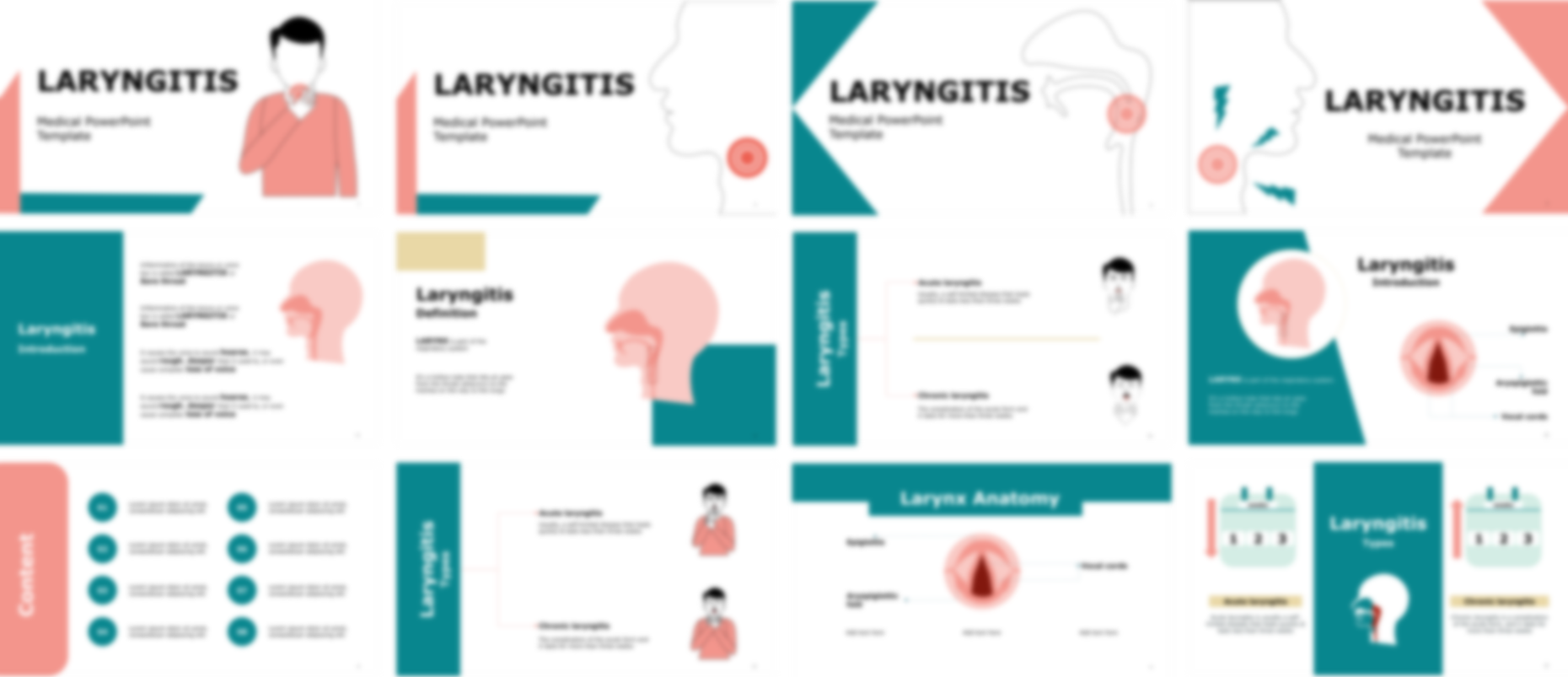
The Laryngitis PowerPoint template opens with creative cover slides before an anatomical introduction describes the larynx as the hollow tube connecting the pharynx to the trachea, detailing the epiglottis, vocal cords, and aryepiglottic fold. A definition slide then explains laryngitis as inflammation of the voice box that causes hoarseness, distinguishing acute from chronic types.
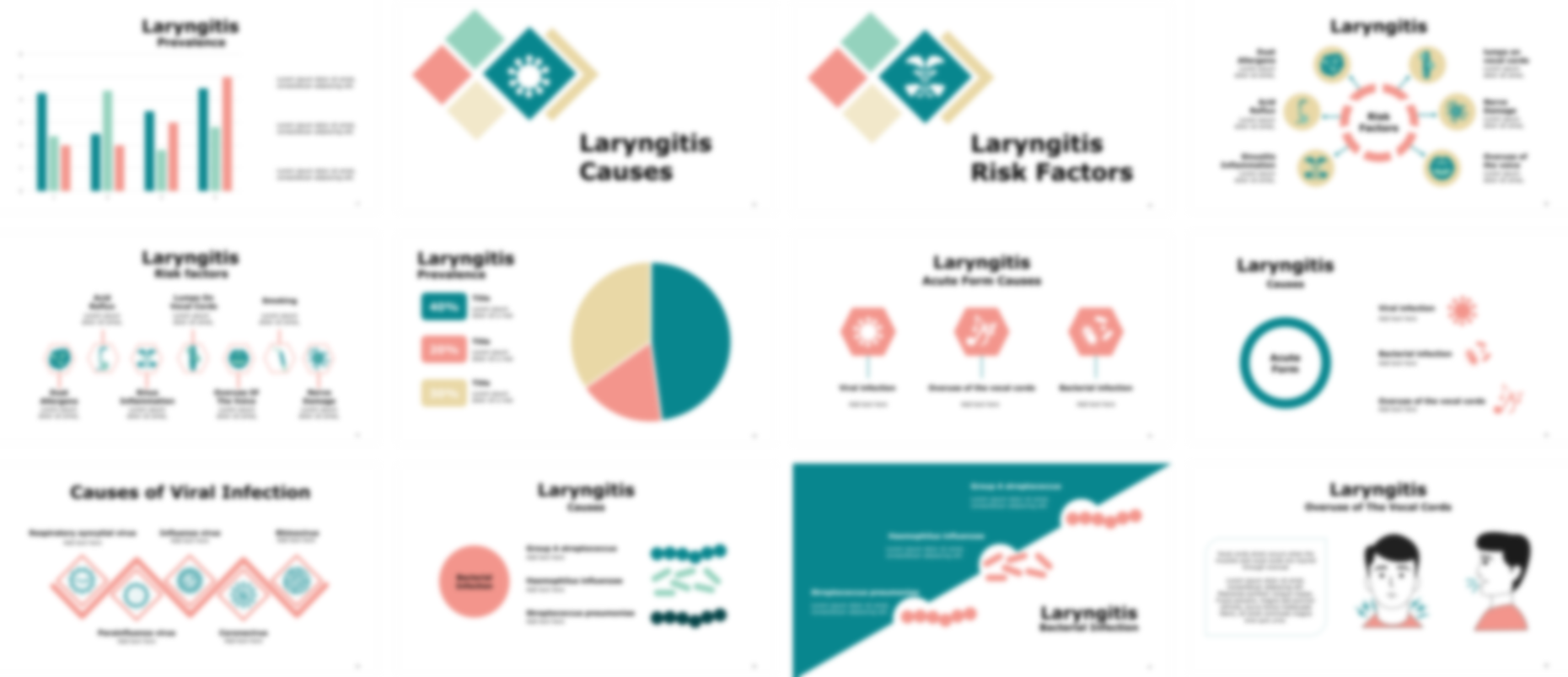
A prevalence infographic with adjustable percentages follows, alongside medical icons covering risk factors including dust allergens, vocal cord lumps, acid reflux, nerve damage, and voice overuse, in this editable medical presentation template. Animated icons then cover causes such as viral infections, including RSV and influenza, bacterial infections such as group A streptococcus, and vocal cord overuse.
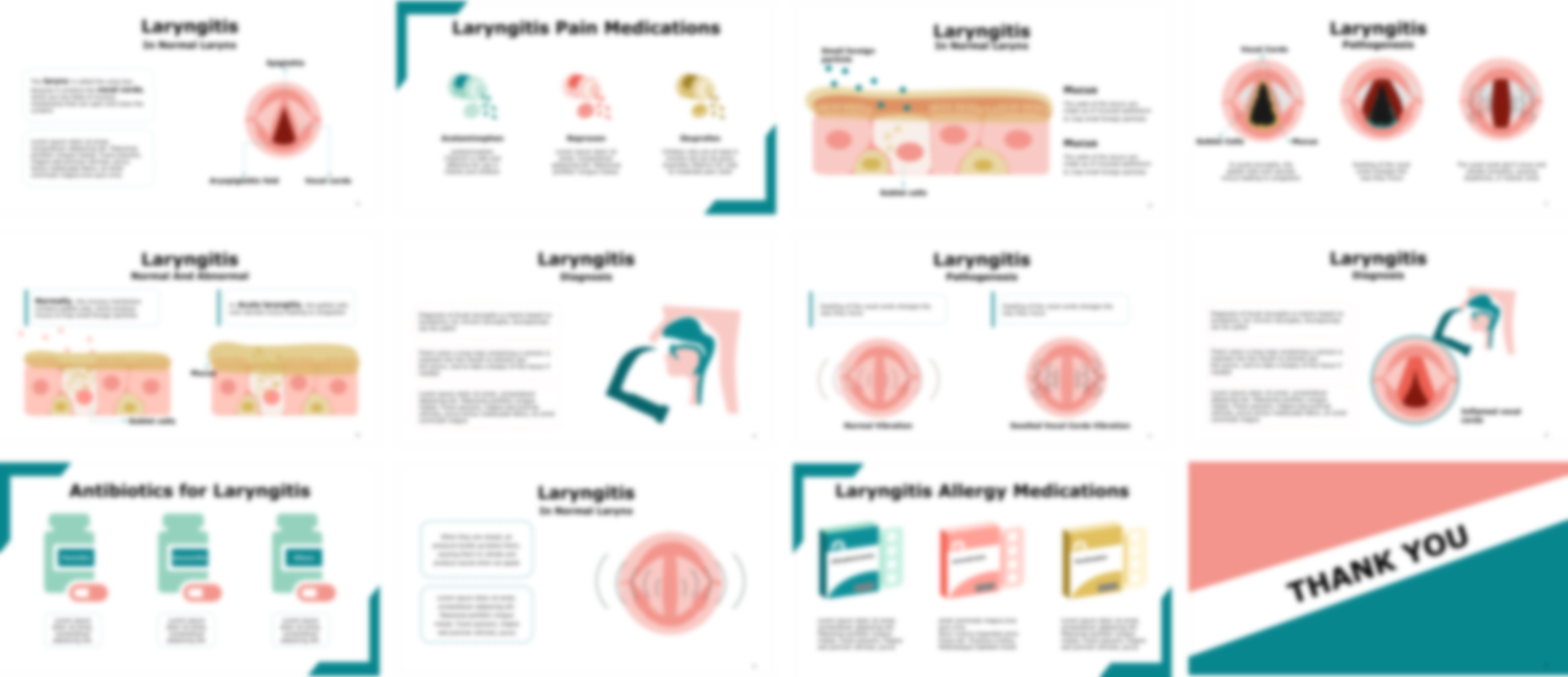
An animated mechanism explains how vocal cords normally open and close to build air pressure and produce sound, tracing the mucosal epithelium's goblet cells that secrete protective mucus. Establishing this normal process first gives educators a shared reference point before the sequence shows how acute laryngitis triggers excess mucus, immune cell inflammation, and vocal cord swelling that disrupts smooth vibration.
Medical icons visualize symptoms including hoarseness, difficulty speaking, sore throat, mild fever, and irritating cough, before diagnostic content covers laryngoscopy for direct visualization and biopsy. The template closes with treatment options including antibiotics, pain medications, and fluid intake, plus a set of customizable icons and illustrations for otolaryngology education.
Ready To Transform Your Presentation ?
Pay once, use forever