Prostatic Cancer PowerPoint Template






Template Preview
Designed for healthcare professionals creating clear and structured medical presentations.
Ideal for doctors, medical educators, and pharmaceutical teams preparing lectures, clinical education, product presentations, and training.
Fully editable in PowerPoint, allowing you to customize diagrams, charts, and slide layouts with your own medical content
Ready-to-use presentation structure that saves time and helps you build professional healthcare presentations quickly.
Fully Animated
Built-in animations help you present medical information clearly and make complex concepts easier to understand.
Editable Colors and Shapes
Editable colors and shapes help you easily customize the slides to match your content and presentation style, just drag and drop your content.
Professional medical layouts
Professional medical layouts help you organize clinical information, medical data, and treatment insights in a clear and structured way.

Created by Medical Professionals
This template prioritizes medical accuracy, clarity, and real-world usability. Each slide is designed with a medical audience in mind, helping you present clinical information, data, and treatment insights in a way that is structured, credible, and easy for healthcare professionals to understand.
Medical Training for Pharmaceutical & Life Sciences Companies
Medical Affairs and Training teams building oncology onboarding content can draw on this animated, 70-plus-slide Prostatic Cancer template to cover prostate anatomy and physiology, the pathogenesis of DNA changes driving uncontrolled cell growth, and the diagnostic role of PSA testing, digital rectal examination, and prostate biopsy. New oncology and urology sales trainees and Medical Science Liaisons get a visual foundation for Gleason grading, TNM staging, and treatment options spanning radical prostatectomy, radiation therapy, and hormone therapy, all illustrated through animated vectors. Because the slide library already spans disease overview through prevention, trainers can adapt sections to their own onboarding schedule instead of building urologic oncology visuals independently. New hires complete training with a working vocabulary for prostate cancer conversations.

Medical Congress & Scientific Conference Presentations
Urologists, oncologists, and radiation oncologists preparing a tumor board presentation or conference talk can adapt this animated template rather than assembling prostate anatomy and staging visuals for each new session. The prevalence infographics, comparing prostate cancer rates by country and region, give speakers dummy data structured for a quick swap to their own institutional statistics. Diagnostic and staging slides covering PSA screening, Gleason score, and TNM classification support a detailed technical discussion for a specialist audience, while the animated pathogenesis sequence helps translate complex cell biology for a mixed academic and clinical audience. A Key Opinion Leader presenting at multiple urology or oncology meetings can reuse the same visual library across sessions of varying depth.

Pharmaceutical Product & Medical Affairs Presentations
Medical Affairs and Medical Communications teams supporting a urologic oncology product can use this presentation as disease-state groundwork for scientific exchange, covering prostate cancer pathogenesis, Gleason grading, TNM staging, and treatment classes including androgen deprivation therapy, radiation, and chemotherapy without referencing a specific brand. Medical Science Liaisons carry the customized, animated slides into advisory boards or KOL scientific discussions, using the disease-state content to build shared understanding ahead of any product-specific data. The presentation's neutral framing keeps it a starting point rather than a finished asset, one that still passes through the customer's own medical and compliance review before field use. Oncology and urology teams gain a consistent, scientifically accurate reference across multiple therapeutic conversations.

eLearning & SCORM Training Modules
Learning & Development teams building oncology training for new urology fellows or infusion nursing staff can customize this Prostatic Cancer template with their own case studies and assessment questions, then convert the finished presentation into a SCORM-compliant module for their learning management system when a self-paced course is the better format. The animated staging and diagnostic-pathway slides translate well into interactive checkpoints within an e-learning course. When a program needs a different scope, for example a screening-focused refresher versus a full disease overview, the RxSlides team can adjust the template's depth and branding accordingly. For training needs no current template addresses, a fully custom presentation can be designed from scratch instead.
Medical & Healthcare Education
Medical school and nursing faculty teaching urologic oncology can use this animated template to walk students through prostate anatomy and the pathogenesis of malignant cell growth without building illustrations independently. The template's diagnostic sequence, covering PSA testing, digital rectal examination, and biopsy, helps students connect screening concepts to the Gleason grading and TNM staging systems used in real clinical decision-making. Coverage of treatment options from active surveillance through radical prostatectomy and hormone therapy gives instructors a visual anchor for discussing multidisciplinary cancer care. Students gain a clearer picture of how screening, diagnosis, and treatment selection fit together in prostate oncology.
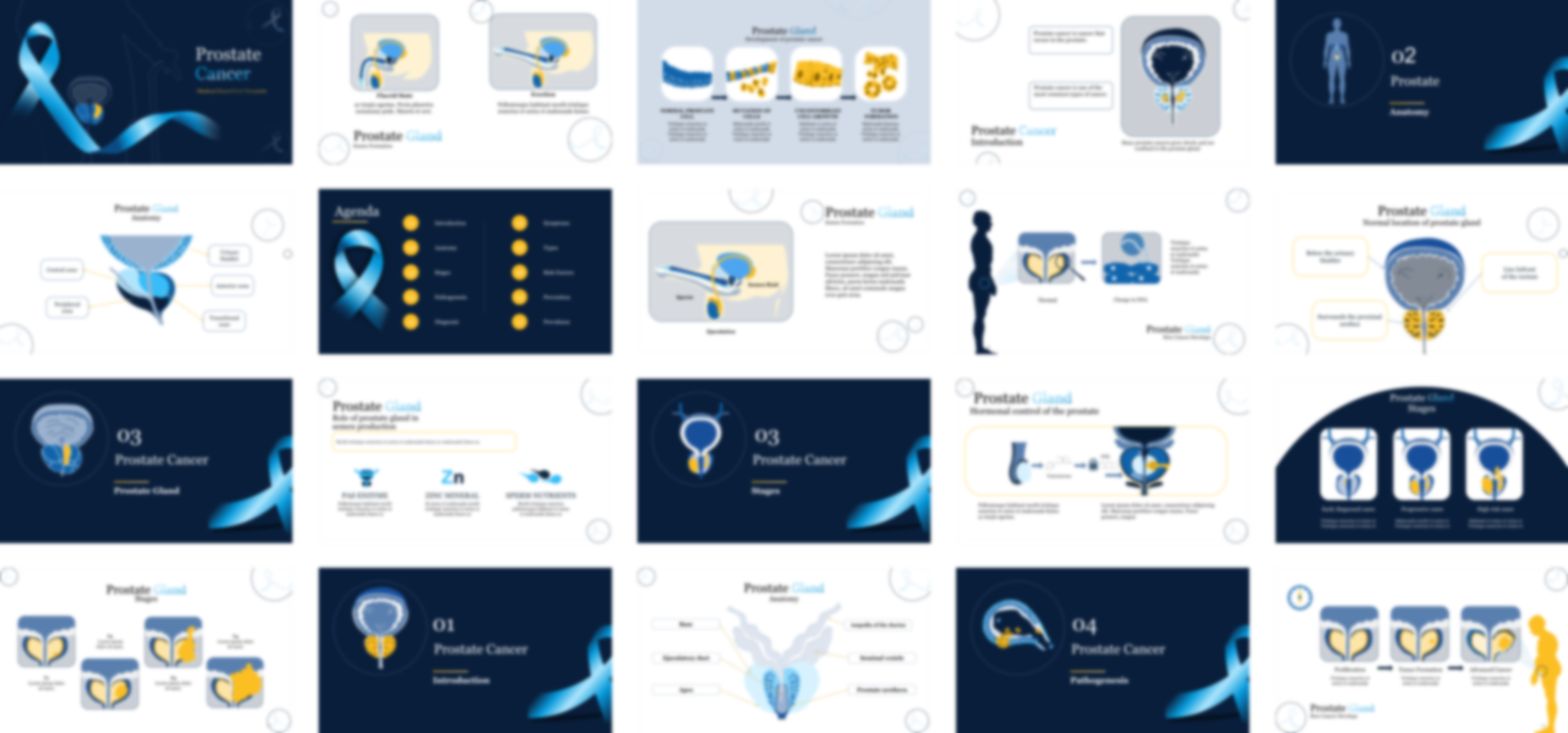


The Prostatic Cancer PowerPoint template opens with simple cover slides before animated illustrations define the disease as prostate cells that start to grow out of control. The anatomy and physiology of the prostate gland are then illustrated, showing the process of semen formation to give the presentation an anatomical foundation in a set of editable medical diagrams.
An infographic with adjustable percentages and country data visualizes the prevalence of prostate cancer on global and local levels. Establishing this data first gives educators a shared reference point before medical icons cover risk factors including family history, age, obesity, and diet.
Animated illustrations explain the pathogenesis of prostate cancer, showing how genetic changes in prostate cell DNA cause abnormal cells to grow and divide more rapidly than normal cells and continue living when other cells die. Further animated illustrations then show the progression of cancer within the prostate gland across its stages.
Medical vectors depict symptoms including frequent pain, urgent urination, nocturia, and blood in the urine before animated illustrations detail diagnostic methods such as digital rectal examination, transrectal ultrasound, prostate cancer gene 3, and prostate specific antigen testing. The presentation closes with preventive methods including a healthy diet, regular exercise, energy management, and avoiding smoking, alongside a dedicated set of editable medical icons and illustrations.
Ready To Transform Your Presentation ?
Pay once, use forever