Urinary system anatomy & physiology PPT Template




Template Preview
Designed for healthcare professionals creating clear and structured medical presentations.
Ideal for doctors, medical educators, and pharmaceutical teams preparing lectures, clinical education, product presentations, and training.
Fully editable in PowerPoint, allowing you to customize diagrams, charts, and slide layouts with your own medical content
Ready-to-use presentation structure that saves time and helps you build professional healthcare presentations quickly.
Fully Animated
Built-in animations help you present medical information clearly and make complex concepts easier to understand.
Editable Colors and Shapes
Editable colors and shapes help you easily customize the slides to match your content and presentation style, just drag and drop your content.
Professional medical layouts
Professional medical layouts help you organize clinical information, medical data, and treatment insights in a clear and structured way.

Created by Medical Professionals
This template prioritizes medical accuracy, clarity, and real-world usability. Each slide is designed with a medical audience in mind, helping you present clinical information, data, and treatment insights in a way that is structured, credible, and easy for healthcare professionals to understand.
Medical Training for Pharmaceutical & Life Sciences Companies
Nephrology and urology training teams onboarding new sales reps can build foundational sessions around this 105-plus-slide Urinary System template, which traces the full path from kidney and nephron structure through the three-stage urine-formation process: glomerular filtration, tubular reabsorption, and tubular secretion. New hires get a visual reference for the male-versus-female anatomical comparison before moving into any disease-specific training, giving them the structural vocabulary needed to follow later product or condition-specific sessions. The urine-composition infographic gives trainees a concrete data point for grounding physiology discussions. New reps finish this foundational training equipped to follow anatomy references across the entire urinary and nephrology product portfolio.

Medical Congress & Scientific Conference Presentations
Nephrologists and physiology educators preparing a foundational session can lean on this Urinary System template's nephron and urine-formation animations rather than assembling filtration diagrams independently. The step-by-step glomerular filtration, reabsorption, and secretion sequence gives a speaker a ready teaching framework for a physiology-focused talk preceding disease-specific content. A Key Opinion Leader opening a nephrology or urology conference track can use the anatomical overview as shared groundwork before speakers move into condition-specific sessions. The kidney and nephron detail keeps the anatomical foundation technically precise for a specialist audience.

Pharmaceutical Product & Medical Affairs Presentations
Medical Affairs teams supporting a renal or nephrology-adjacent product can use this Urinary System presentation as anatomical and physiological groundwork for scientific exchange, establishing shared understanding of nephron function and urine formation before any product-specific mechanism is introduced. Medical Science Liaisons can reference the filtration-reabsorption-secretion sequence when a scientific exchange conversation requires grounding in normal renal physiology before discussing a drug's site of action. Because the presentation covers normal anatomy and physiology rather than a specific product, Medical Affairs gets a reference that still requires the customer's own medical and compliance sign-off before any field use. Nephrology and urology teams gain a consistent anatomical reference usable across an entire portfolio of renal and urinary products.

eLearning & SCORM Training Modules
Nursing and pharmacy schools building a foundational renal physiology module can customize this Urinary System template with their own assessment questions, then convert the finished presentation into a SCORM-compliant module for their learning management system when self-paced study fits the curriculum better. The nephron-structure and urine-formation animations translate naturally into interactive checkpoints within an anatomy and physiology course sequence. When a program needs a narrower scope, such as nephron function alone or a version tailored for nursing versus medical school learners, the RxSlides team can adjust the template's coverage and branding. For a foundational course that doesn't fit any current template, the RxSlides team can also put together a fully custom presentation from scratch.
Medical & Healthcare Education
Medical and nursing faculty teaching renal physiology can use this template's kidney and nephron illustrations to establish the anatomical basis before introducing the three-stage urine-formation process. The male-versus-female comparison gives students a clear anatomical reference that's difficult to convey through text-based diagrams alone. The urine-composition infographic connects the physiological process to a concrete clinical data point students can reference in later coursework. Students leave with the structural and functional foundation needed before progressing into disease-specific urinary and renal coursework.
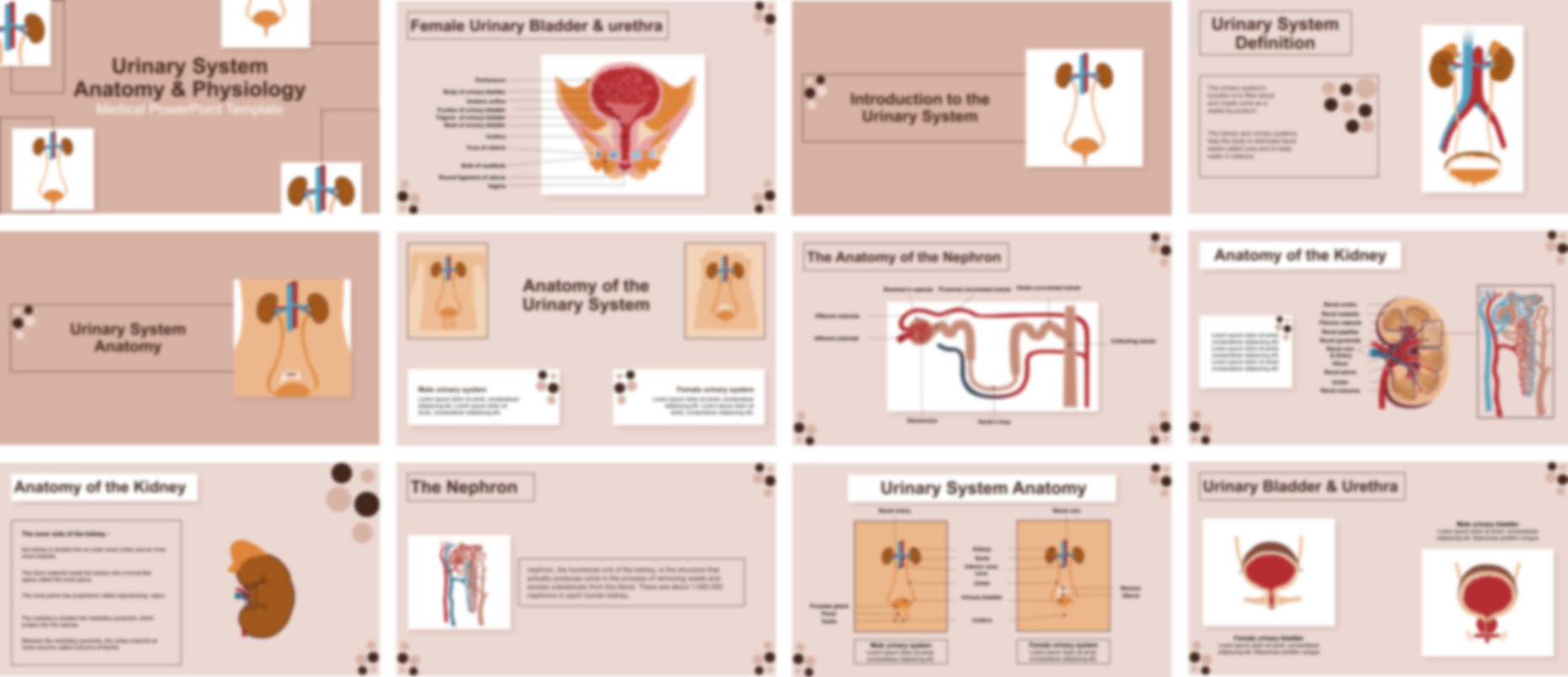
The Urinary System Anatomy and Physiology PowerPoint template opens with animated illustrations describing the system as a whole, followed by a visual breakdown of blood filtration and urine production as its primary function, and a comparative illustration that places the male and female urinary systems side by side to highlight their anatomical differences.
Animated slides illustrate the complete structure of the kidney before a dedicated diagram isolates the nephron, the functional unit responsible for blood filtration, in modifiable illustrations suited for detailed physiology teaching. Establishing the nephron's structure first gives educators a shared foundation before the template explains how this structure performs its filtering role.
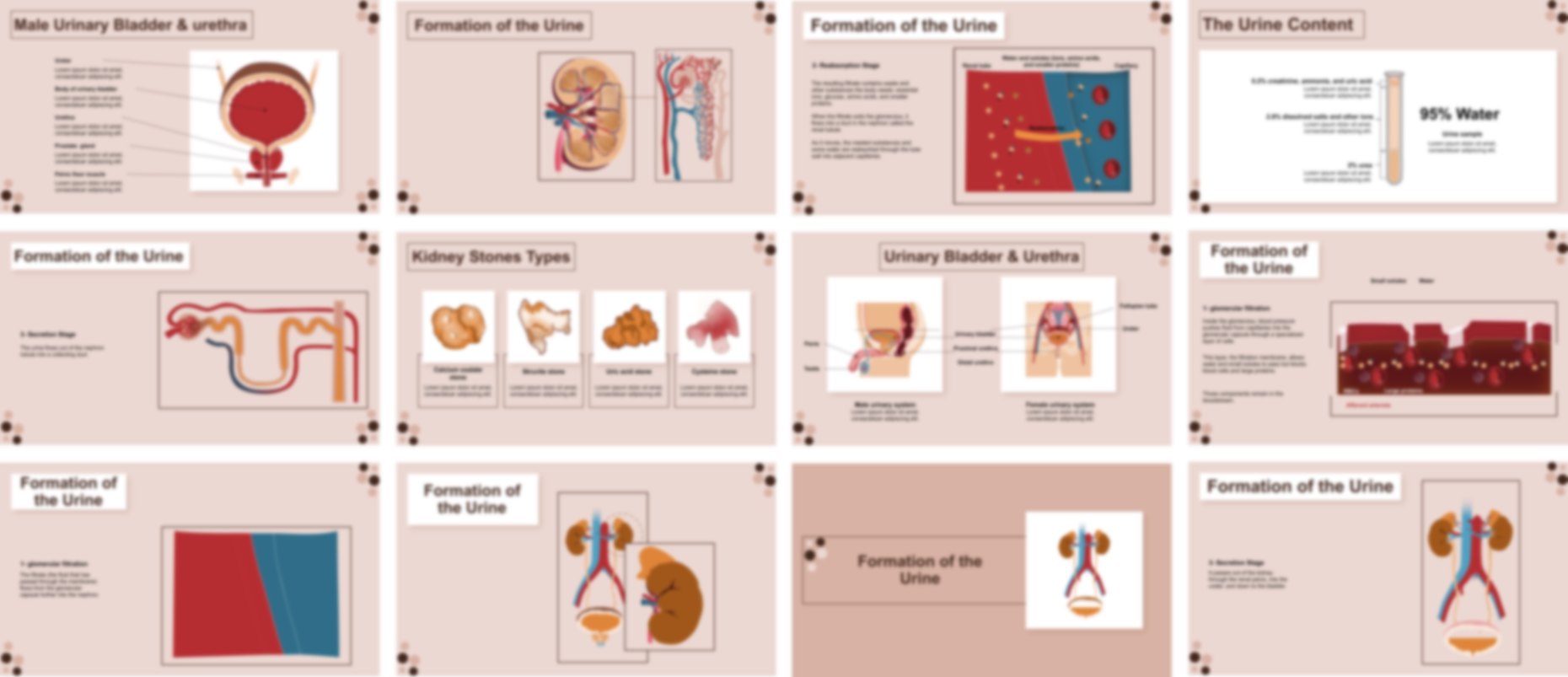
Animated slides illustrate the anatomy of the urinary bladder and urethra in both males and females, highlighting the differing accessory glands between the two sexes with fully editable text and icons. An infographic then breaks down the typical components of urine by percentage, giving presenters a customizable reference for discussing renal filtration output.
A series of animated illustrations walks through the three stages of urine formation, glomerular filtration, reabsorption, and secretion, clarifying how the nephron stabilizes blood pressure while producing urine. The presentation template closes with a full collection of urinary system icons and illustrations, rounding out a set of editable medical diagrams for anatomy instruction.
Ready To Transform Your Presentation ?
Pay once, use forever